Artículo wiki · Colección 08
ARM Cortex
Referencia técnica sobre ARM Cortex para el diseño, integración e implementación de sistemas de energía inalámbrica.
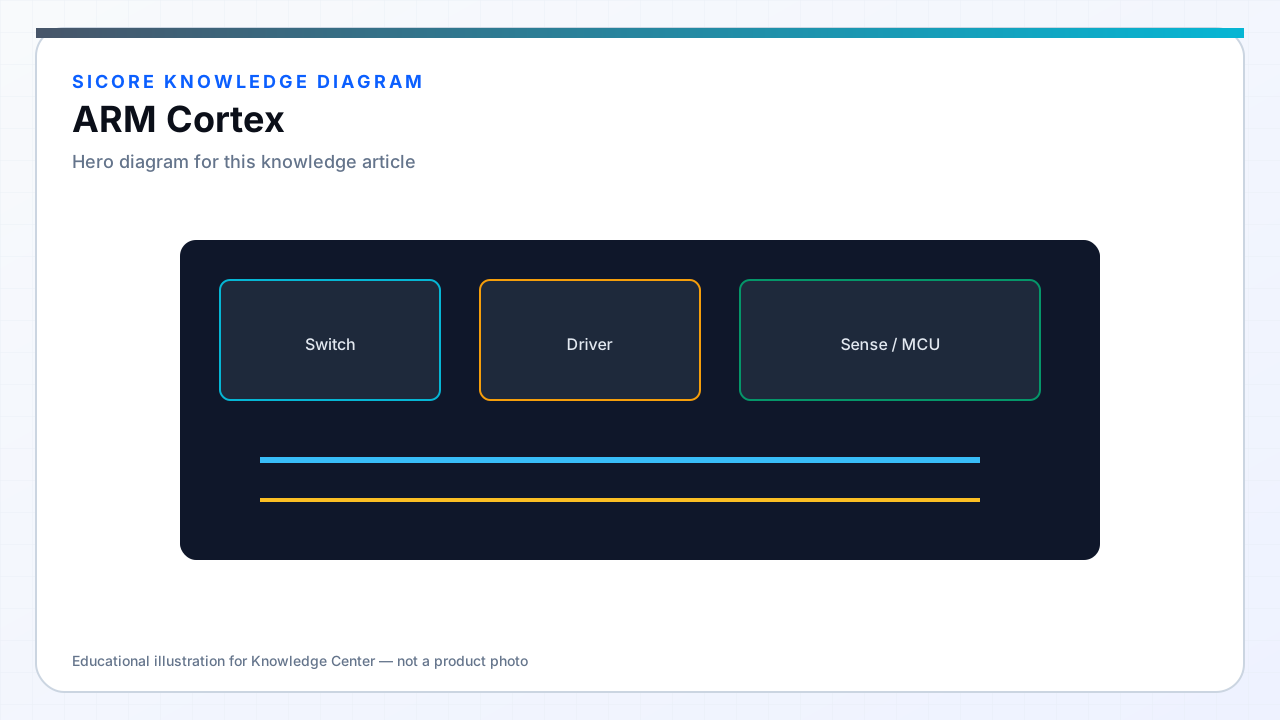
ARM Cortex-M cores dominate industrial motor and power electronics firmware because toolchain support, third-party RTOS availability, and peripheral IP ecosystems are mature. SiCore dock and receiver designs map workload severity to core class: lightweight CAN gateway tasks on M0+, closed-loop power control on M4F, and TrustZone-capable M33 where secure OTA and credential storage are required alongside real-time control.
Core selection interacts directly with wireless charging safety architecture: faster cores reduce control-loop period but increase EMI from switching logic unless clock gating and sleep modes are disciplined.
01Core class comparison
- Cortex-M0/M0+: minimal cost and power; suitable for BMS-facing CAN bridges, LED status, and slow sensor polling — not primary inverter loops.
- Cortex-M3/M4: mainstream for power stages; M4F adds single-precision FPU and DSP instructions for resonant control.
- Cortex-M33: optional TrustZone, MPU, and FPU — separates secure boot/OTA from application firmware on connected pads.
- Cortex-M7: high performance for multi-phase digital power and Ethernet-heavy dock gateways; higher BOM and thermal load.
02MPU, FPU, and safety usage
Memory Protection Unit configuration isolates RTOS tasks — communication stack buffers cannot overwrite PWM duty registers if task boundaries are enforced. FPU context save on exception entry adds latency; SiCore ISR paths that touch FPU registers either avoid floating point in ISRs or use lazy stacking with measured worst-case stack depth.
For SIL-oriented designs, vendor safety libraries and dual-channel compare hardware pair with Cortex-M4 at the power control layer while a separate safety MCU or lockstep core handles watchdog and STO (safe torque off) equivalent paths for wireless power disable.
03Ecosystem and longevity
Keil, IAR, and GCC support across STM32, NXP, Microchip, and Infineon parts reduces toolchain lock-in when supply constraints force silicon migration. SiCore BSP layers abstract timer and ADC HAL differences so application control code survives MCU family changes with bounded re-validation on HIL benches.