Artículo wiki · Colección 10
CISPR
Referencia técnica sobre CISPR para el diseño, integración e implementación de sistemas de energía inalámbrica.
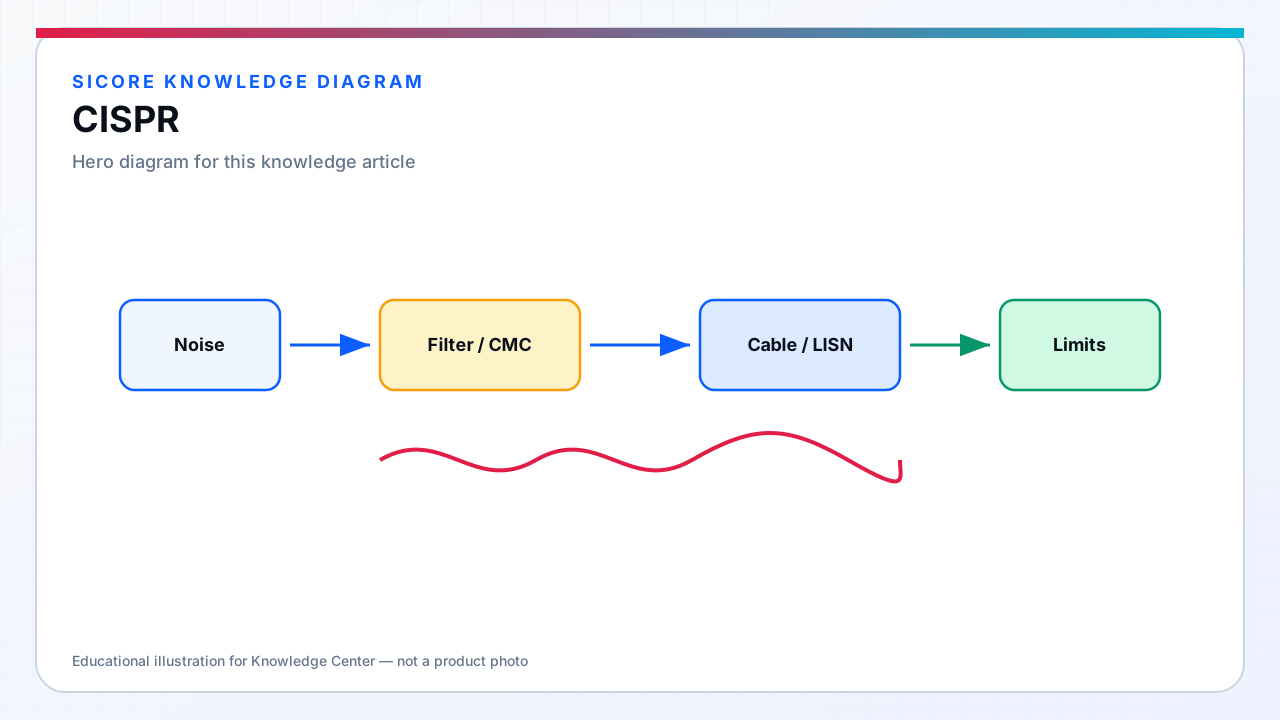
The International Special Committee on Radio Interference (CISPR) publishes limits and measurement methods adopted globally through regional standards — EN 55011 in Europe, ANSI C63.4 references in North America. SiCore high-power wireless charging docks align with CISPR 11 for industrial, scientific, and medical equipment when classified as power conversion apparatus operating in industrial environments. CISPR defines frequency ranges, detector types, measurement distances, and limit lines that differ from consumer CISPR 32/35 products — applying wrong limits wastes engineering effort or creates certification risk.
WPT operation adds a controlled intentional radiator at 85–150 kHz while CISPR 11 measurements typically span 9 kHz to 400 MHz or higher depending on class. SiCore distinguishes between ISM band provisions for wireless power and harmonic emissions subject to standard limit curves — operating frequency registration and harmonic suppression are documented separately in the technical file.
01CISPR 11 essentials
- Group 1 vs Group 2: intentional RF energy users (Group 2) may have distinct provisions — WPT classification requires legal review per region.
- Class A (industrial) vs Class B (residential): limit levels and deployment restrictions differ.
- Conducted emission: measured on AC mains via LISN — quasi-peak (QP) and average (AV) limits per frequency band.
- Radiated emission: rod or biconical/log-periodic antennas at 3 m or 10 m distance per frequency range and power class.
- Measurement bandwidth and dwell time: 9 kHz RBW at low frequency, 120 kHz above 30 MHz — peak readings compared to QP limits per procedure.
02WPT-specific CISPR considerations
Floor-flush dock radiated tests may require custom mounting to represent installed geometry — pit cavity, adjacent steel, and concrete affect low-frequency H-field and E-field results. Operating mode during test: maximum certified power, worst-case alignment within specification, and all cooling fans at maximum speed (worst-case acoustic noise correlates with worst-case conducted emission from motor drives where present).
Harmonics of the switching frequency and intermodulation products from PFC switching (typically 20–100 kHz) often dominate below 1 MHz; layout and filter design target these before investing in chamber time above 30 MHz. CISPR 14 and 15 apply to adjacent product categories — SiCore avoids misclassification that triggers inappropriate plug-and-play appliance limits on fixed installed docks.
03Compliance workflow
SiCore maintains correlation between internal semi-anechoic pre-scans and accredited lab results — systematic delta documented per product generation. Failures trigger root-cause hierarchy: operating mode validity, grounding and LISN setup, then hardware revision. CISPR test reports include photographs, cable routing, and firmware version — fleet customers audit these during vendor qualification for global logistics rollouts.