
Artículo wiki · Colección 10
Apantallamiento
Referencia técnica sobre Apantallamiento para el diseño, integración e implementación de sistemas de energía inalámbrica.
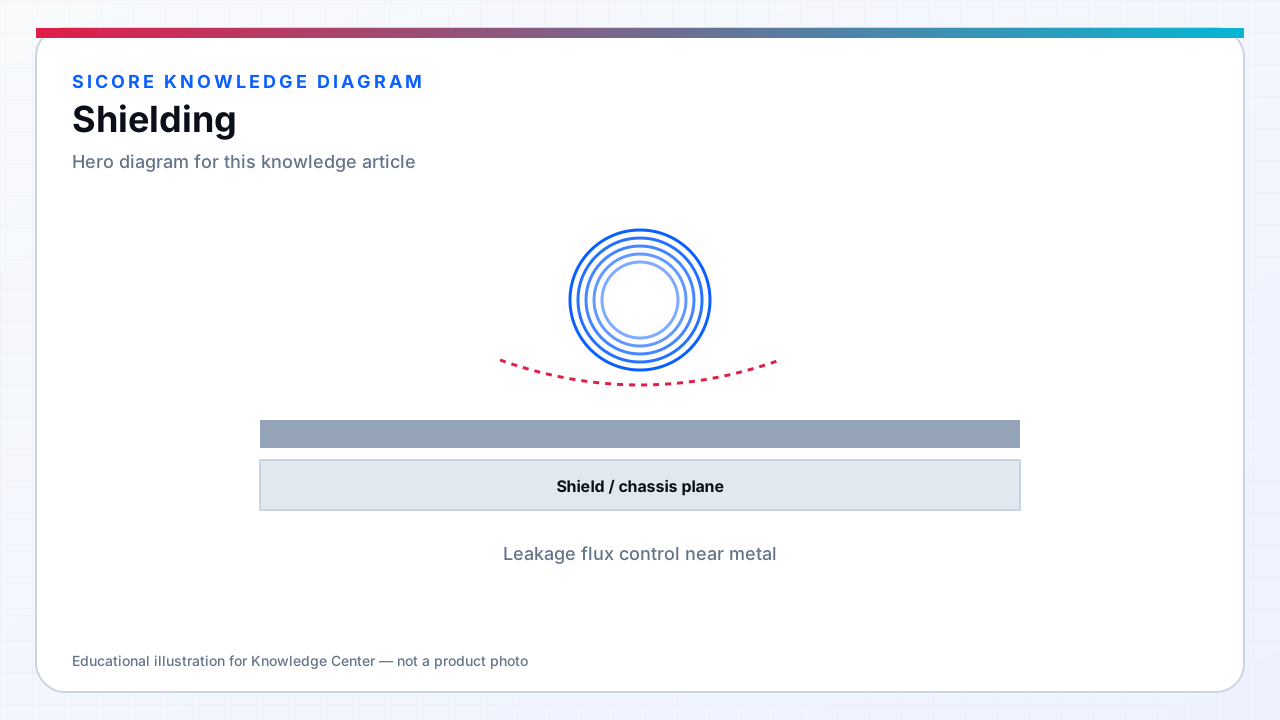
Shielding attenuates electromagnetic fields by reflection, absorption, and multiple reflection within enclosed volumes — implemented through conductive enclosures, gaskets, cable entry filters, and selective metallization. SiCore wireless charging products face a fundamental tension: resonant WPT requires intentional magnetic coupling through the pad surface, while inverter harmonics and switching noise must not escape the dock pit or receiver compartment to disturb facility networks and neighboring automation.
Floor-flush dock designs use aluminum or steel pit liners, sealed electronics boxes, and ferrite-backed coil assemblies to shape intentional fields downward while limiting upward fringing. AGV receivers mount in steel or aluminum belly enclosures where chassis conductivity provides partial shielding but also creates eddy-current loss and modified field topology during charge — shielding design must account for vehicle-specific geometry.
01Enclosure and seam design
- Continuous conductive path: lid-to-base contact via conductive gasket or machined flange — target < λ/20 slot length at highest concern frequency.
- Fastener pitch and grounding screws: avoid isolated cover panels that become slot antennas.
- Display and vent apertures: honeycomb vents, conductive mesh, or redirected airflow paths that preserve IP rating and shield integrity.
- Cable penetrations: filtered connectors or feed-through capacitors — unfiltered holes defeat solid-wall shielding.
- PCB-level shields: stamped cans over gate drivers, oscillators, and sensitive analog front-ends on receiver control boards.
02Material selection and effectiveness
Aluminum enclosures offer weight advantage and good high-frequency reflection; steel provides higher permeability benefit for low-frequency H-field attenuation but adds mass and corrosion considerations in wash-down zones. Nickel-plated copper tape and conductive elastomers bridge gaps where mechanical tolerance prevents metal-to-metal contact across large dock plates. Shielding effectiveness is frequency-dependent — a sealed box excellent at 30 MHz may leak at 150 kHz WPT fundamental if the coil aperture is uncontrolled.
SiCore does not rely on shielding alone for compliance: source reduction through layout and filtering remains primary; shielding provides margin and protects internal subsystems from mutual interference between inverter, comms, and safety MCU domains on multi-board dock controllers.
03WPT-specific shielding trade-offs
Over-shielding the transmit coil face reduces coupling efficiency and increases reflected power — ferrite flux guides and aluminum back-plates are dimensioned to redirect fringing without blocking the intentional flux path to the receiver. Receiver-side ferrite shields protect onboard electronics from the dock field while maintaining open face orientation toward the pad. Commissioning includes verification that added shielding revisions do not shift detuning or foreign-object sensitivity beyond calibrated limits.