
Artículo wiki · Colección 05
Control Adaptativo de Potencia
Referencia técnica sobre Control Adaptativo de Potencia para el diseño, integración e implementación de sistemas de energía inalámbrica.
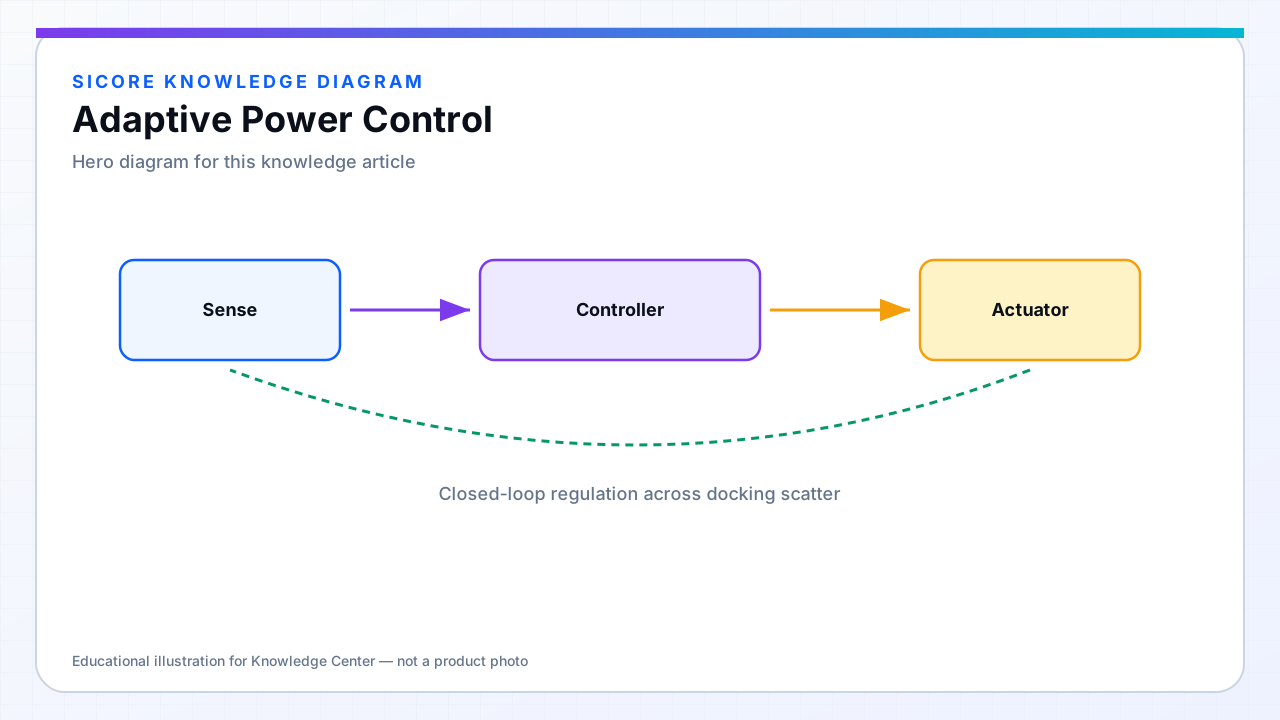
Adaptive power control continuously reshapes the charging setpoint as the wireless link and battery state evolve. Unlike a fixed CC/CV profile tuned for one alignment, an adaptive controller reads link quality, temperature, and pack feedback each cycle and moves the operating point to stay inside safe ZVS, FOD, and thermal envelopes.
In industrial docks the coupling coefficient k and equivalent load resistance change every park — lateral offset, worn tires, payload variation, and ambient temperature all shift the resonant gain curve. Adaptive control treats those shifts as expected inputs, not faults.
01What the controller adapts
- Delivered power vs gap quality: reduce when misalignment raises stress, increase when the link is strong and cool.
- Frequency and phase targets as the tank detunes with heat or metal proximity.
- Current ramp rates during SOC transitions to avoid overshoot on aged packs.
- Thermal derating on pad ferrite, coil Litz, and vehicle receiver without hard shutdown unless limits are breached.
02SiCore implementation mindset
SiCore pairs resonant hardware with a multi-loop controller: an inner loop holds soft switching and link stability; an outer loop optimizes charge rate against fleet SLA and battery health. Adaptation is bounded — the controller never chases peak lab efficiency at the expense of FOD margin or semiconductor SOA.
03Fleet operations payoff
Operators see fewer failed dock cycles and less variance in minutes-to-ready across robots on the same charger. Telemetry from adaptive decisions — why power was limited on a given cycle — becomes actionable maintenance data instead of unexplained slow charges.