
Artículo wiki · Colección 03
Simulación de Bobinas
Referencia técnica sobre Simulación de Bobinas para el diseño, integración e implementación de sistemas de energía inalámbrica.
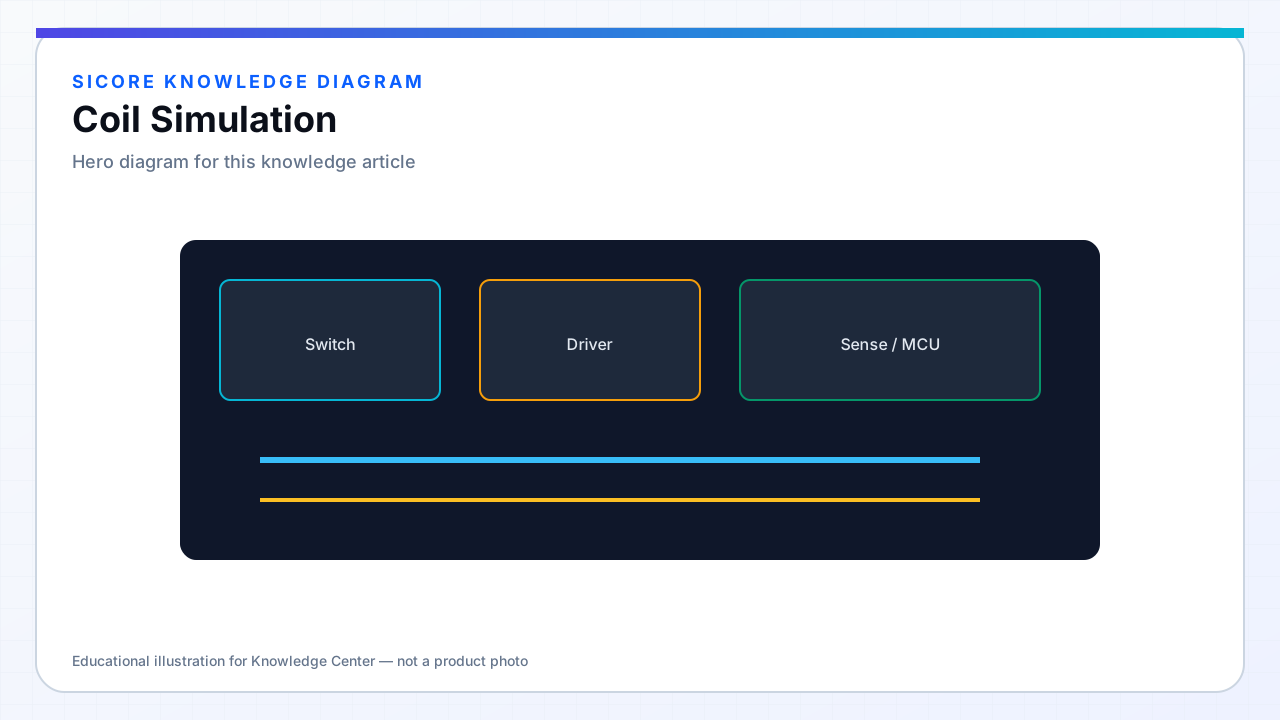
Coil simulation predicts inductance, resistance, coupling, and field patterns before cutting copper. Analytical formulas and 2D axisymmetric models give fast iteration; 3D finite-element models include ferrite saturation, shields, and chassis steel at the cost of setup time and mesh expertise.
Simulation must include frequency effects: AC resistance proxies, ferrite loss models, and optionally eddy currents in nearby conductors. A DC magnetostatic FEM result is insufficient for resonant charger design.
01Model build checklist
- Full current path including return conductor or mirror boundary.
- Ferrite B-H curves and loss data at operating frequency.
- Mesh refinement in skin depth regions for copper (when supported).
- Parametric sweeps for gap and lateral offset.
02Correlation to test
Compare simulated L, k, and field maps to impedance analyzer and hall-probe or search-coil measurements on the same fixture. Track simulation error across builds — a model consistently off by 8% on L is still useful if bias is stable. Update models when potting compounds or ferrite lots change.
03Limits
- Manufacturing tolerance on wire placement not captured in ideal CAD.
- Temperature-dependent material properties during continuous operation.
- Complex fleet environments (random metal debris) are not in standard FEM.