
Wiki article · Collection 07
Battery Safety
Engineering reference on Battery Safety for wireless power system design, integration, and deployment.
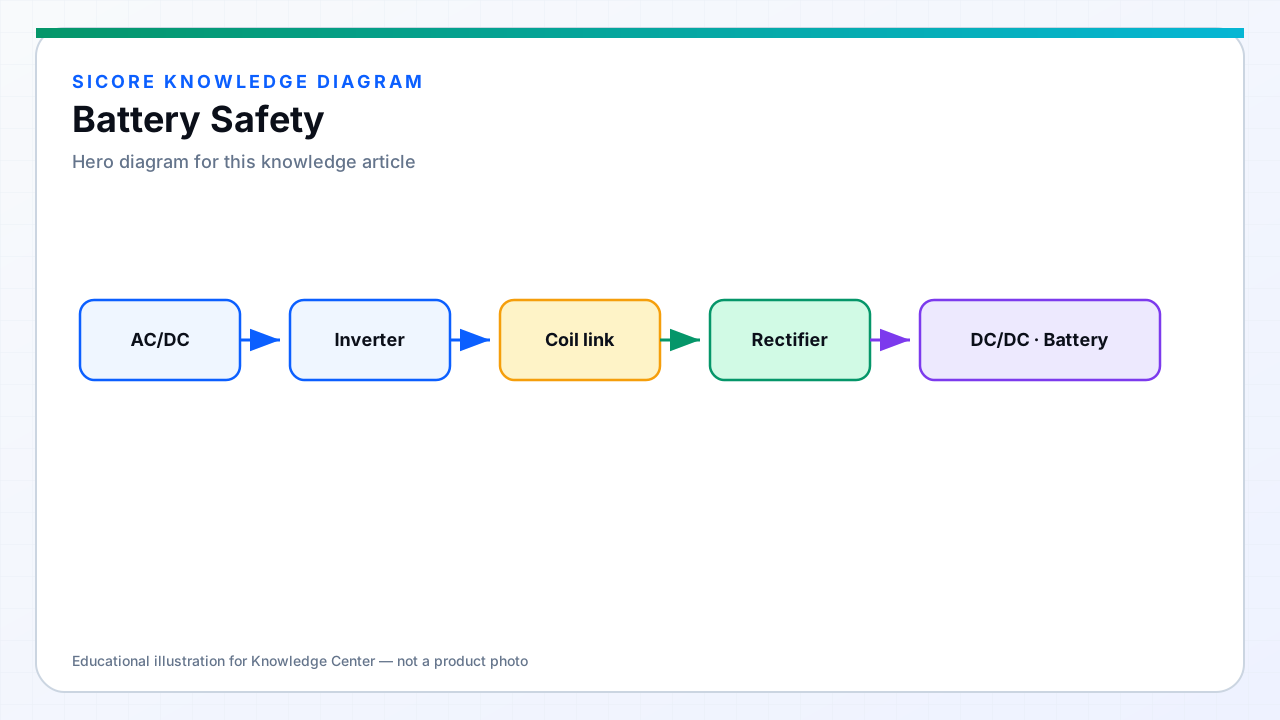
Traction battery safety in industrial environments combines electrical isolation, thermal containment, fault detection, and emergency response procedures. Wireless charging adds the requirement that power transfer stop reliably when the vehicle moves, when foreign objects enter the coupling gap, or when the BMS declares a fault — without relying on an operator to unplug a cable.
SiCore safety design treats the wireless link as part of the charge safety chain alongside BMS contactors, fusing, and ground-fault monitoring — not a separate convenience layer.
01Protection layers
- Cell-level: fuse, vent, and chemistry selection to reduce thermal runaway propagation risk.
- Pack-level: contactors, pre-charge, HVIL (high-voltage interlock), and enclosure flame barriers.
- Charge path: overcurrent, overvoltage, reverse polarity, and isolation monitoring on receiver output.
- Wireless-specific: FOD (foreign object detection), living object detection, and comm-loss shutdown.
- Facility: smoke detection, fire suppression, and clearances per local electrical and fire codes.
02Fault response during wireless charge
On BMS fault — over-temperature, cell over-voltage, isolation failure — the contactor opens and the wireless transmitter must de-energize within milliseconds via comm-loss timeout or explicit fault signal. SiCore pads implement staged power removal: immediate gate drive disable on critical faults, controlled ramp on non-critical taper requests.
Mechanical safety interlocks prevent motion with HV energized where vehicle standards require: charge sessions lock drive motors or require parking brake confirmation before power transfer begins.
03Maintenance and incident prevention
Regular inspection covers pack enclosure integrity, vent obstruction, receiver cable wear, and BMS fault log review. Swollen cells, recurring imbalance alarms, or rising charge session abort rates trigger pack quarantine before catastrophic failure. SiCore session logs provide forensic data — power, duration, alignment, abort reason — for post-incident analysis.