Wiki article · Collection 07
Fast Charging
Engineering reference on Fast Charging for wireless power system design, integration, and deployment.
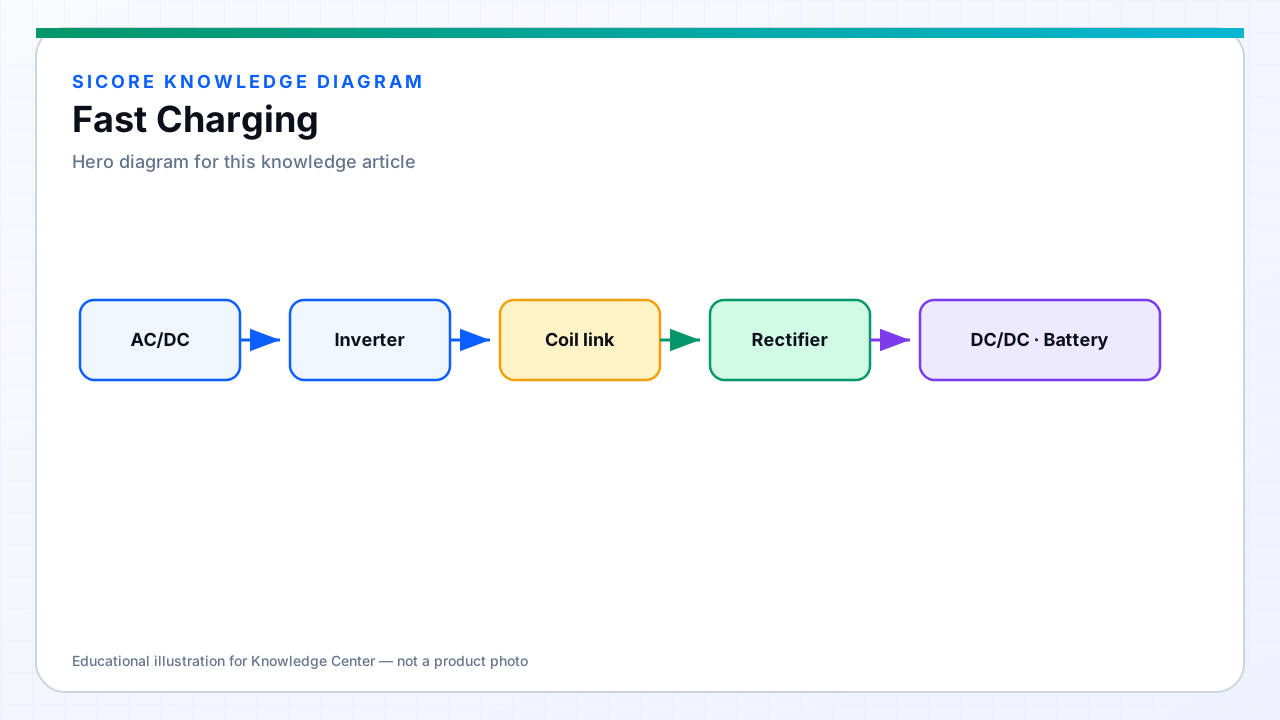
Fast charging minimizes robot idle time by delivering maximum safe charge current during short dock windows. Wireless fast charging removes connector wear and operator steps, but power transfer is bounded by coil coupling, receiver thermal limits, BMS current requests, and cell chemistry acceptance — not by inverter nameplate rating alone.
SiCore fast-charge profiles stage power: ramp after dock handshake, hold at peak within BMS limits, taper as cell voltage rises, and terminate at fleet SOC target rather than always charging to 100%.
01Limiting factors
- BMS maximum charge current (C-rate) and per-cell voltage ceiling.
- Receiver and onboard charger thermal capacity during sustained high-power transfer.
- Coupling coefficient k at actual dock alignment — lower k means higher primary current for same secondary power.
- Cell temperature: cold packs derate charge; hot packs trigger taper or session abort.
- Grid or facility power budget when multiple pads charge concurrently.
02Charge taper and SOC targets
Constant-current charging dominates the early phase; as cell voltage approaches the limit, the BMS transitions to constant-voltage taper where accepted current falls. Opportunity-charging fleets often stop at 70–85% SOC because the last 15–20% charges slowly and generates disproportionate heat — better to release the pad for the next robot.
SiCore session logic supports configurable SOC stop targets and adaptive taper coordination so pad dwell time matches workflow timing rather than forcing full charge every cycle.
03Concurrent fast charging
Warehouses sizing multiple high-power pads must account for demand overlap: three 10 kW wireless sessions overlapping can exceed branch circuit capacity without load management. SiCore fleet power management can prioritize pads, stagger peak power, or derate non-critical sessions — always respecting individual BMS limits per vehicle.