
Wiki article · Collection 07
SOC
Engineering reference on SOC for wireless power system design, integration, and deployment.
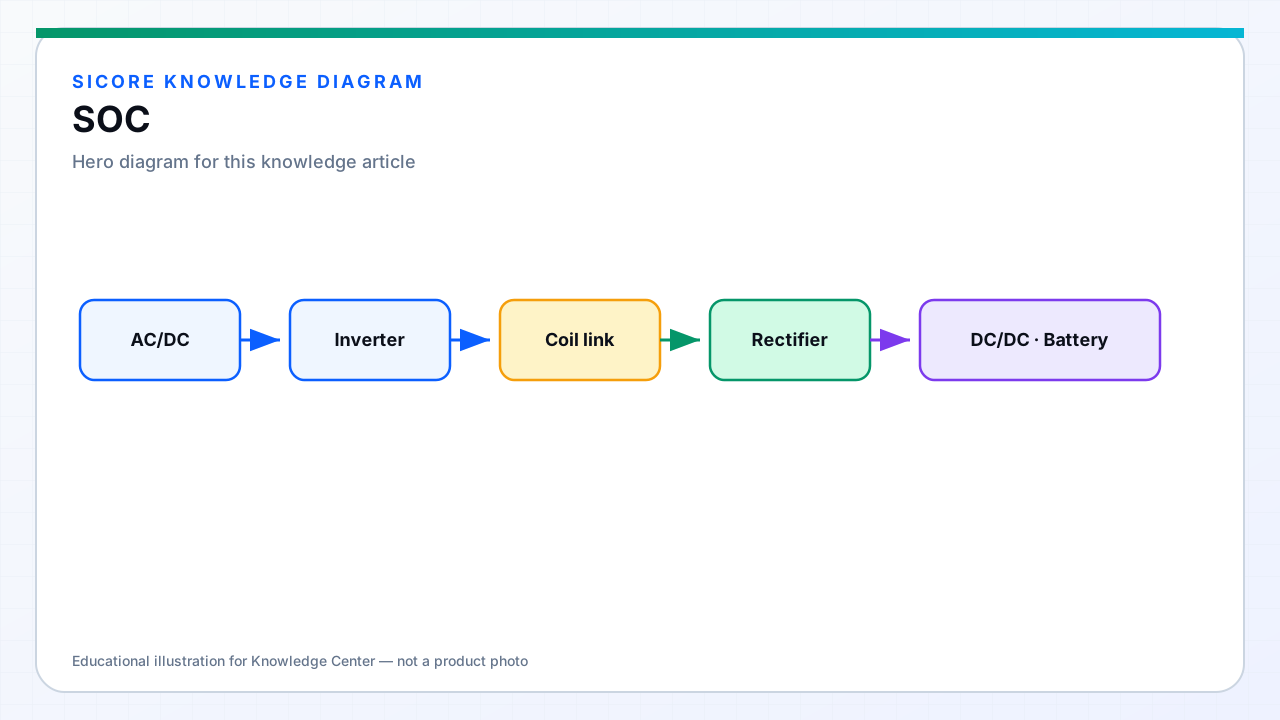
State of Charge (SOC) is the fraction of remaining usable energy in the traction pack, expressed as a percentage. Fleet dispatch logic, wireless charge scheduling, and mission assignment all depend on accurate, stable SOC reporting — a robot released at 35% SOC on a long route creates throughput risk; one held at a pad at 85% SOC wastes dock capacity.
SOC is not directly measurable: the BMS estimates it from current integration (coulomb counting), open-circuit voltage (OCV) correlation, and sometimes model-based fusion. Wireless charging adds estimation challenges because frequent partial charges and load transients during dock approach disturb OCV-based corrections.
01SOC estimation methods
- Coulomb counting: integrate charge/discharge current over time; drifts without periodic recalibration at known rest points.
- OCV lookup: map rested cell voltage to SOC; chemistry-specific tables; unreliable under load or immediately after charge.
- Kalman or observer models: fuse current, voltage, temperature, and internal resistance for dynamic accuracy.
- Full charge anchor: periodic complete charge to 100% resets accumulated error — rare in opportunity-charging fleets.
02Fleet SOC policies
Industrial fleets define SOC bands for mission release, charge dispatch, and emergency reserve. A typical AMR policy: release missions above 40% SOC, trigger charge routing below 30%, and hard-block below 15%. SiCore wireless systems subscribe to BMS SOC broadcasts so charge sessions start and stop at fleet-configured thresholds without overriding pack safety limits.
Opportunity charging complicates band management: robots may sit at 60–80% SOC most of the shift rather than swinging 20–100%. SOC estimation must remain accurate in the mid-range where OCV curves are flattest — especially for LFP chemistry.
03Wireless charging and SOC reporting
During wireless charge sessions the BMS reports rising SOC to fleet software in real time. SiCore telemetry correlates delivered pad energy (kWh from the transmitter) with BMS-reported SOC delta to detect calibration drift or unexpected load during charge. Discrepancies flag BMS recalibration needs or receiver efficiency degradation before robots leave docks with less energy than dispatch assumes.